Introduction to Fundamental Analysis in Forex
What is fundamental analysis in forex? Learn the 6 key economic factors that move currency prices and how to apply them in your trading.
Fundamental analysis is how you work out which economy behind a currency is getting stronger or weaker, so you know which direction a currency is likely to head before you ever look at a chart.
In short
- A currency reflects the health of its economy. When the economy strengthens, the currency tends to strengthen with it.
- Six things do most of the moving: interest rates (the big one), growth, jobs, inflation, the trade balance, and politics.
- Fundamentals tell you which way to trade. Technicals tell you when. The strongest setups pair a strong currency against a weak one.
How it works
Think of each currency as a share in a country's economy. If you owned shares in a company, you would care about its profits, its debts, and where it is headed. A currency works the same way: its price reflects how healthy the economy behind it looks compared to the economy on the other side of the pair.
That is all fundamental analysis is: evaluating a currency by examining the economic, political, and social factors that influence its value. Where technical analysis studies price charts and patterns to guess where price might go next, fundamental analysis answers a different question: why is a currency strong or weak in the first place? The core principle is simple. A growing economy with rising interest rates attracts foreign investment, that investment has to be bought in the local currency, and that demand pushes the currency up.
| Fundamental | Technical |
|---|---|
| Why price moves | Where price might go |
| Economic data & news | Charts & patterns |
| Sets direction | Improves timing |
Most successful traders use both: fundamentals to decide which direction to trade, technicals to find the entry and exit. Here the non-obvious part, the one that trips up even experienced traders: it is never one economy in isolation. A currency pair is a contest between two economies, so what matters is the gap between them. The US economy can be slowing and the dollar can still rise, as long as it is slowing less than the eurozone.
Six factors do most of the work, roughly in order of how hard they hit:
- Interest rates (the big one). Higher rates attract foreign capital chasing better returns, more demand means a stronger currency. This is the engine behind the carry trade strategy. Watch central bank rate decisions, forward guidance, and how inflation compares to the bank's target. Our Dot Plot guide covers how the Fed signals its next move.
- GDP growth. Strong output signals a healthy economy and lifts demand for its currency. Compare the relative growth rates between the two countries, not the headline number alone.
- Employment data. A core read on economic health. The US Non-Farm Payrolls (NFP) report is the most market-moving monthly release, and it routinely whips USD pairs around on release.
- Inflation. The effect depends entirely on how the central bank is expected to respond. High inflation can push the bank to raise rates to cool things down, which tends to strengthen the currency. Low inflation can invite rate cuts to stimulate growth, which tends to weaken it. Markets trade the expectation, so if a hike is already "priced in," the actual announcement may barely move anything.
- Trade balance. A surplus (exports greater than imports) means foreign buyers need the currency to pay for goods, which supports it. A deficit (imports greater than exports) sends more currency flowing out, which tends to weaken it.
- Political and geopolitical factors. Elections, policy shifts, and unexpected events can trigger sudden volatility. Stability tends to support a currency, uncertainty tends to weaken it.
The number is only half the story
Two things decide how a currency reacts to a release, not just the data itself. First, expectations: the market moves on the surprise versus what was already expected, so a strong number everyone saw coming can do nothing, while a small miss can move price hard. Second, the mood of the day: in calm, risk-seeking markets traders chase growth and yield, but in nervous, risk-off markets they run to safe havens like the Dollar or Yen even when the data points the other way. Always read a release against what was expected and the mood it lands in.
Deeper dive
Knowing the six factors is the easy part. Applying them in real time is where most retail traders stall. Proper fundamental analysis means tracking, every week:
- Economic calendars across 8+ countries
- Central bank statements and speeches
- Dozens of monthly indicators
- Breaking news and shifting sentiment
- Institutional positioning via COT reports
That is a lot. Institutional desks have dedicated research teams for exactly this. Most retail traders do not have 2 to 3 hours a day to stay on top of it, and the data is scattered across dozens of sources that each tell only part of the story.
This is the gap Forex Fundamentals is built to close: it does the heavy lifting and presents everything in one clear, actionable view, updated daily.
Currency bias scores
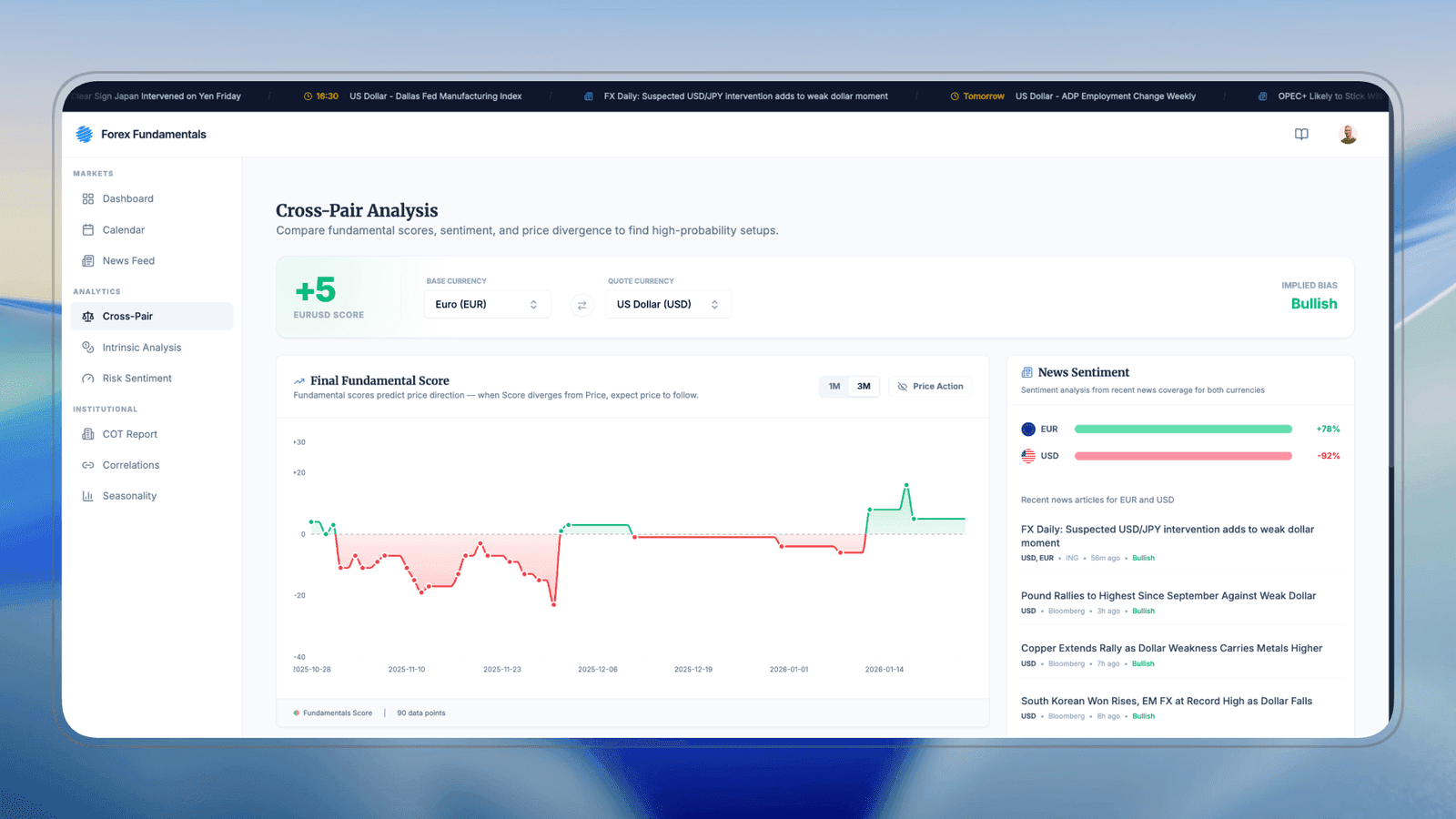
We aggregate economic data, central bank policy, and market conditions into a single fundamental score per currency. At a glance you can see which currencies are fundamentally strong, neutral, or weak, which is exactly what you need to pair strength against weakness for data-driven trade ideas.
Real-time sentiment
Fundamentals tell you what should happen. Sentiment tells you when the market is ready to act on it. The platform monitors news flow, central bank communications, and market commentary to give a live sentiment read for each currency. When sentiment lines up with the fundamentals, you have a high-conviction setup rather than a hunch.
Putting it to work
The workflow is the same one institutional desks use, just compressed:
- Build a bias per currency. Is USD bullish or bearish on current fundamentals? What about EUR? Score each currency on its own first. Each major has its own fundamental personality, broken down in the guides to the US dollar, euro, pound, yen, Australian dollar, Canadian dollar, Swiss franc and New Zealand dollar.
- Check sentiment. Fundamentals set the direction, sentiment drives the near-term move. See how the market is reading the latest data.
- Look for trends, not points. One data print rarely shifts the picture. Is inflation trending higher over several months? Is employment consistently strong? Trends confirm or challenge your bias.
- Stay systematic. Do not react to every headline. Focus on high-impact events for your pairs and let a structured dashboard filter the noise.
Rule of the desk
Fundamentals set the direction, technicals set the timing. Trade a fundamentally strong currency against a fundamentally weak one, never two strong or two weak currencies against each other.
See it in the data
You can track 8+ economic calendars, read every central bank statement, and build your own currency scores by hand. Or you can open Forex Fundamentals and read it off a dashboard: a single fundamental score per currency, a live sentiment read, and an economic calendar that tells you why each release matters and how it could shift bias, all updated daily. The question is not whether fundamentals give you an edge, they do, but whether you want to spend your mornings assembling the picture or trading it.
Keep reading
The Carry Trade: Profiting from Interest Rate Differentials
Borrow cheap money, park it in a higher-yielding currency, pocket the spread. Here is how the carry trade actually works, and why it collects pennies for years then loses big in a panic.
Central BanksThe Dot Plot Explained: Reading the Fed's Mind
Why the Summary of Economic Projections (SEP) moves markets more than the rate decision itself.
COT & PositioningUsing CoT Data to Spot Reversals
Learn to identify overcrowded trades using z-scores, positioning divergences, and the 'flip' signal: a step-by-step framework for spotting institutional liquidation setups.