Mastering Fundamental Analysis Forex: Where to Begin
Learn the essentials of fundamental analysis forex, including macroeconomic factors, news events, and how institutions forecast currency trends.
Fundamental analysis is reading the health of an economy to work out whether its currency is about to get stronger or weaker.
If you have ever watched a perfectly good technical setup fail instantly because of a sudden price spike, you have experienced the power of fundamentals. Many retail traders spend years mastering chart patterns, only to find themselves blindsided by market movements they did not see coming. Technical analysis tells you when to enter a trade. Fundamental analysis tells you why the market is moving, and where it is going next.
In short
- A currency is a proxy for its economy: when the economy strengthens, the currency usually strengthens with it.
- Three things move a currency most: central bank interest rate policy, political stability, and trade flows.
- The job is to find the gap between a currency's true value and its current price, then trade in that direction.
How it works
At its heart, fundamental analysis in forex is the study of supply and demand on a global scale, an approach professionals call global macro analysis: viewing each currency as a claim on an entire economy. Just as a stock trader reads a company's balance sheet to decide whether a stock is cheap or expensive, a forex trader reads a country's economic conditions to judge the value of its currency.
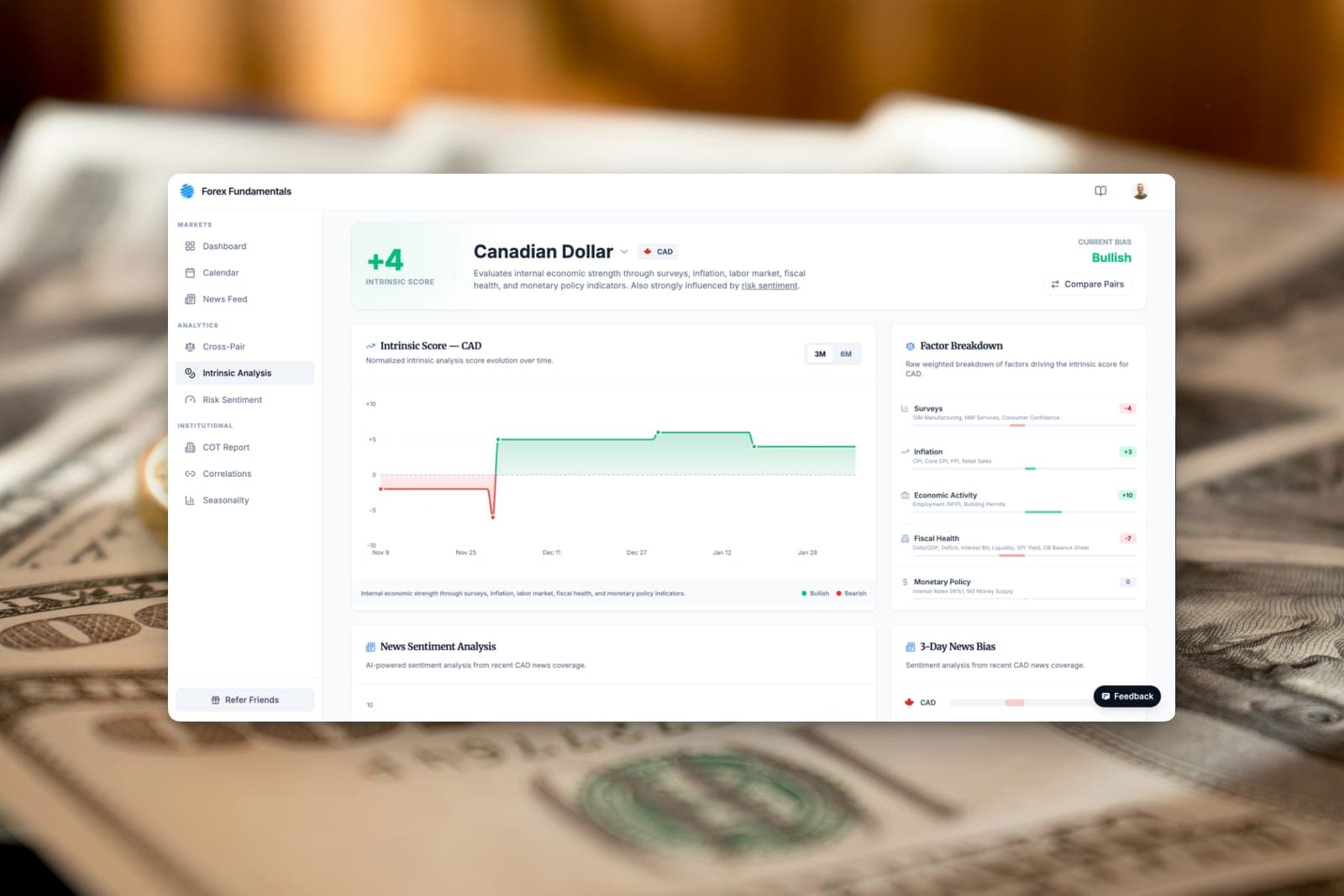
A currency is a proxy for its economy
A currency is essentially a proxy for the country behind it. When an economy is growing, its currency tends to strengthen. A strong economy leads to higher interest rates, and higher rates attract foreign investors looking for a better return on their capital. To read these conditions, traders watch data points like GDP growth (the total output of the economy), inflation rates, and employment figures. These metrics are the fuel for currency trends. Strong data pushes the central bank toward raising rates, which lifts the currency. Weak data pushes it toward cutting rates, which weakens the currency.
Intrinsic value: the price-tag analogy
One of the most powerful concepts in fundamental trading is intrinsic value: the calculated "true" value of a currency based on economic data and purchasing power, as opposed to its current market price. Think of it like a house that is clearly worth more than its asking price. The fundamentals (the location, the condition) say one thing, the sticker says another, and the gap is the opportunity.
Markets are not always efficient. Fear, greed, and speculation can push a currency's price far away from its intrinsic value. A fundamental trader looks for these discrepancies. If your analysis shows the Euro is undervalued against the US Dollar based on economic performance, you have a high-probability bias to go long.
A gap is not a trade on its own
Intrinsic value is a compass for direction, not a timer. A currency that looks cheap can stay cheap for months, because price only moves once the market's expectations shift and a catalyst arrives. Two traps to avoid: do not fight a strong trend just because your model says "undervalued," and remember a data point only moves price when it surprises versus what was already expected. Use intrinsic value to pick a side, then wait for sentiment and the chart to confirm the market is starting to agree.
The three factors that matter most
While there are hundreds of economic indicators, successful global macro analysis boils down to three primary fundamental factors:
- Central bank policy: the number one driver of currency trends. Interest rates dictate the flow of money around the world.
- Geopolitics and stability: capital seeks safety. Political instability scares away investors and weakens the currency.
- Trade flows: countries with a trade surplus (exporting more than they import) naturally see higher demand for their currency.
Deeper dive
Once the mechanism is clear, the next step is knowing where to point it: which assets, which events, and how the professionals actually run the analysis.
Why focus on major pairs
Fundamental analysis is most effective when applied to major pairs such as EUR/USD, USD/JPY, and GBP/USD. These pairs possess the deepest liquidity and are heavily traded by large institutions. Because of that volume, they tend to respect macroeconomic data more reliably than exotic pairs, which can be easily moved by low volume or erratic speculation. When the US economy shows strength, USD/JPY reacts logically; an obscure exotic pair might not.
News analysis versus noise
A common trap for beginners is trying to trade every single news release. Effective news analysis means filtering out the noise and focusing on high-impact events.
Key Event: Non-Farm Payrolls
The undisputed king of market-moving events is the Non-Farm Payroll report (NFP) released by the United States. It measures the number of jobs added to the US economy (excluding farm workers) and serves as a key gauge of economic health. A strong NFP number often leads to a rally in the US Dollar, while a weak number can cause a sell-off. Learning to interpret the NFP is a prerequisite for understanding forex volatility.
How institutions actually do it
Retail traders often wonder how the "smart money," the big banks and hedge funds, approach the market. They do not rely on simple trend lines. They use data-driven models and deep research.
Institutions run sophisticated quantitative tests and econometric models (statistical models that turn economic data into a probability) to measure currency strength. These models input vast amounts of data, including interest rate differentials, inflation expectations, and growth forecasts, and output a probability of a currency's direction. Building these models from scratch is incredibly complex for the average trader, but access to the data is becoming easier. Platforms like Forex Fundamentals bridge this gap, running the econometric models in the background and presenting the result in a single, user-friendly interface.
You also do not have to do all the heavy lifting yourself. Major banks like Goldman Sachs, Citibank, and Deutsche Bank publish financial institutions forecasts: reports detailing their outlook on currency pairs for the coming months or years. The challenge has always been aggregating these scattered reports. A service that consolidates reports from major news sources and banks lets you quickly see the consensus of the "smart money," so instead of hunting for PDFs you get a unified fundamental outlook.
Building your system
Knowledge without execution is useless. A solid fundamental trading strategy combines macro analysis with technical execution. A simple framework looks like this:
- Analyze the macro bias: use your econometric data to decide whether the economy is improving or deteriorating, which gives you a direction (long or short).
- Check the sentiment: are the aggregated financial institutions forecasts aligning with your view?
- Technical entry: use charts to find a safe entry point in the direction of your fundamental bias.
For a more rigid approach, you can build fundamental trading systems that follow strict rules based on data, for example: "I will only look for buy signals on GBP/USD if UK inflation is rising and the Bank of England has signaled a rate hike." Codifying your analysis into rules removes emotion and keeps you trading in line with the economic reality.
Rule of the desk
Technical analysis times your entry, but fundamentals give you the conviction to hold for the big moves. Never let a chart pattern talk you into a trade that fights the economic reality.
See it in the data
You can build your own spreadsheets, hunt down bank PDFs, and code econometric models from scratch. Or you can open Forex Fundamentals and read the fundamental outlook off a dashboard: the econometric models, the aggregated bank forecasts, and the macro data are combined for you in one place. Start by analyzing the intrinsic value of one major pair this week. That is the first step toward trading like a professional.
Keep reading
Introduction to Fundamental Analysis in Forex
What is fundamental analysis in forex? Learn the 6 key economic factors that move currency prices and how to apply them in your trading.
COT & PositioningCOT Report Explained: Why Most Traders Read It Wrong
The CFTC publishes three different Commitment of Traders reports. Most traders only use the Legacy report, and that is a mistake. Learn which report to use for forex, commodities, and why the distinction matters.
StrategyThe Best Forex Swing Trading Strategy: A Fundamental Approach
Discover why combining fundamental analysis with swing trading creates the highest-probability setups for capturing multi-day moves in forex.